

Signs Your Church Pews Need Restoration, Not Just Cleaning
Cleaning removes what is sitting on top of the finish. Restoration replaces the finish itself. Knowing which problem you have saves a committee a lot of time, and it is something you can determine in one walk through your own sanctuary.
Where Cleaning Stops and Restoration Starts
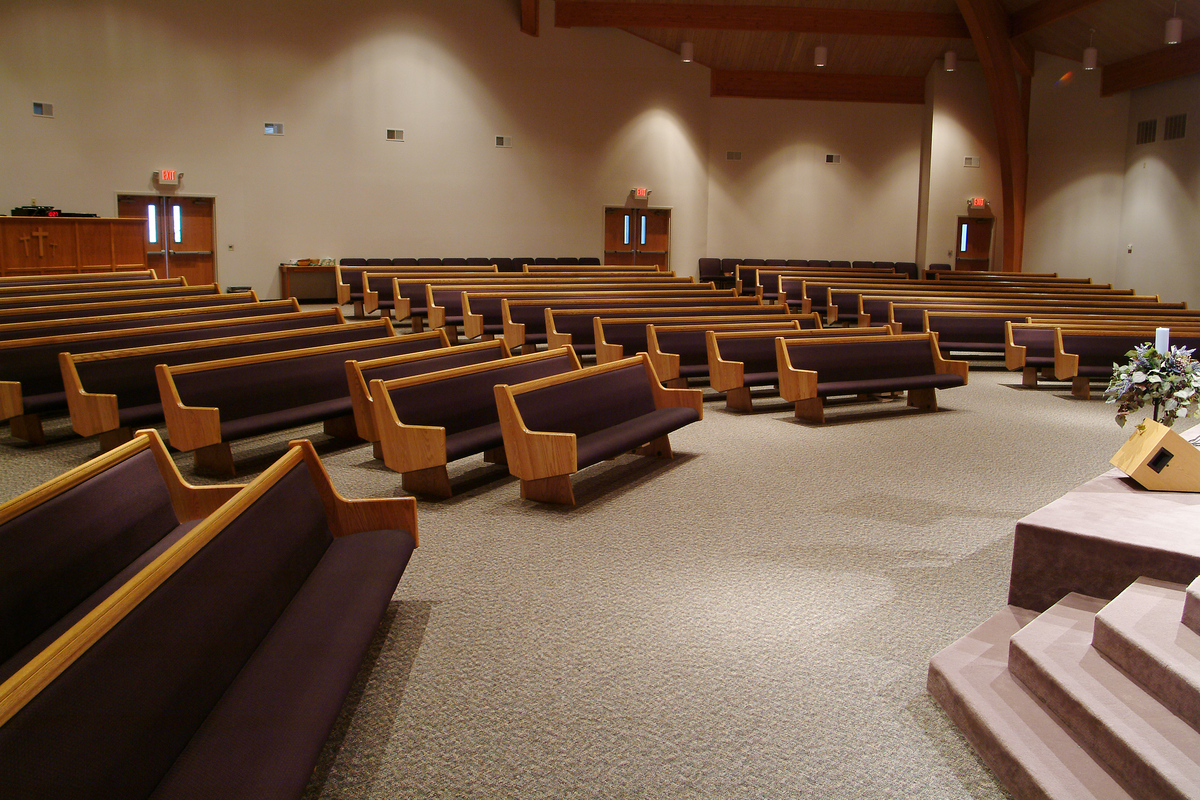
Church pews are one of the few things in a building that get used hard, every week, for decades, and then get judged on how they look. Most congregations respond to that by cleaning more often. Sometimes that is exactly right. Often it is treating a finish problem as a housekeeping problem, and no amount of scrubbing will close the gap.
The distinction is simple once you know where to look. A finish is a protective coat sitting on top of the wood. Cleaning works on everything above that coat: dust, oils from hands, wax buildup, spills, the residue left behind by the last three products someone tried. Restoration works on the coat itself, and on the wood and joinery beneath it. When the coat has worn away, clouded, or stopped sealing the wood, cleaning has nothing left to act on.
| What you are seeing | What it usually is |
|---|---|
| Dull, filmy surface that wipes brighter and stays brighter | Buildup on top of an intact finish. A cleaning issue. |
| Dull, chalky surface that wipes brighter and dulls again within days | Finish is thin or failing. A restoration issue. |
| Sticky or tacky feel across whole pews | Wax and polish accumulation. Usually cleaning, sometimes stripping. |
| Bare, lighter-colored wood at the armrests and seat edges | Finish worn through. A restoration issue. |
| Pew moves or creaks under weight | Joinery, not finish. Inspect before anything else. |
Kivett's has been refinishing and manufacturing church pews entirely in-house since 1958, as a second-generation family-owned company, and runs the largest refinishing division on the East Coast out of one plant in Clinton, North Carolina. The team that evaluates a sanctuary is the team that does the work, which is the main reason an evaluation can be specific rather than hedged.
Back to topThe Walkthrough: Checking Your Own Pews
You do not need a specialist to gather the facts. You need good light and about half an hour. Turn the sanctuary lights all the way up, and if there is daylight through the windows, use that too. Low light hides exactly the problems you are trying to find.
Where to Look, In Order
- The armrests and pew ends of the back four rows. These take the most hand contact in most sanctuaries and show wear first.
- The front edge of the seat, near the aisle. This is where people slide in and out, and where the finish gives way earliest.
- The kneelers, if you have them. Check the hardware and the hinge points, not just the padding.
- The pews nearest an exterior wall, a window, or an HVAC vent. Moisture and temperature swings do their damage locally, so these will not match the rest of the room.
- Underneath. Look at the joint where the pew body meets the pew end, on two or three pews spread across the room.
Write down what you find by row number. A committee that arrives at a consultation with "rows 1 through 6 on the east wall are cloudy, the back four rows are worn through on the armrests, pew 14 rocks" gets a far more precise answer than one that reports the pews look tired.
Five Signs a Cleaning Will Not Fix
1. The finish has worn through to bare wood
Look at the armrests and the seat edges. If there is a patch where the color is lighter than the surrounding wood and the surface feels different, dry or slightly rough rather than smooth, the protective coat is gone in that spot. That bare wood is now absorbing hand oils and moisture directly, and it will keep darkening unevenly until it is sealed again. Cleaning a bare patch does not restore the coat; it just cleans bare wood.
2. Cloudy or white patches that do not wipe away
A milky haze inside the finish, rather than on top of it, is moisture that has gotten into the coating. Humidity swings across seasons cause it, so do window and roof leaks, and so does repeated cleaning with a damp cloth. The tell is that it does not respond to wiping, and often looks worse right after cleaning because the surface is wet. The wood underneath is usually still perfectly sound. What failed is the layer over it.
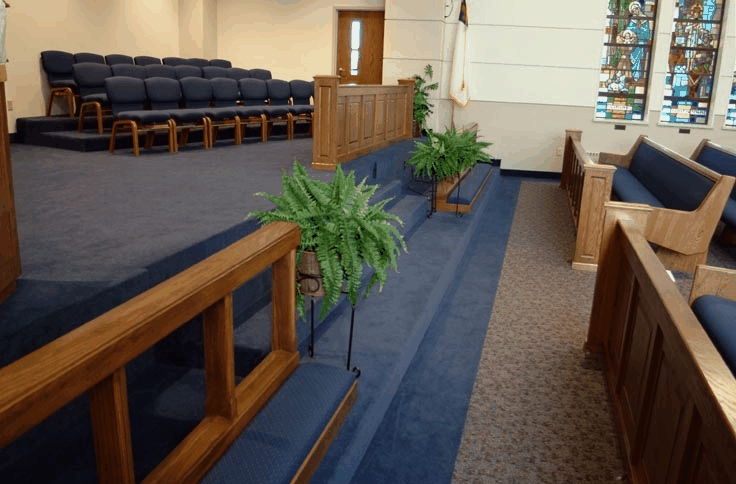
A sound finish is continuous and even across the seat, the end, and the armrest. Wear shows up at the contact points first.
3. Any movement in the pew
Push firmly on the back of a pew and watch the base. If there is any rock, sway, or audible creak, that is joinery, and joinery is not a finish issue at all. Wood joints loosen slowly for years and then fail over a short period. A pew that moves when a person stands up from it should be looked at before the next service, not at the next budget meeting. This one sign is worth calling about on its own.
4. Upholstery worn through, flattened, or splitting at the seams
Fabric that has thinned to the point of showing the backing, foam that no longer returns to shape, seams that have opened along the front edge: none of these are cleaning problems, and cleaning stressed fabric tends to accelerate the failure. Reupholstery is a separate scope from refinishing and can be done on its own, though most congregations combine the two because the pews are already out of the sanctuary. Kivett's handles upholstery in-house as well, and the fabric and stain options are worth reviewing before a committee sets a budget.
5. Damage that follows the building rather than the seating
If the problems concentrate near one wall, one window, or one vent instead of spreading evenly across the room, the building is doing something to the pews. Water intrusion, a heating or cooling vent blowing directly onto wood, or sustained humidity in one corner will all produce that pattern. Restoration will fix what is on the pews. It will not fix what caused it, so this is the one finding worth chasing down on the building side at the same time. Our post on what causes church pew damage over time covers the common culprits in more detail.
Back to topWhat to Do With What You Found
If everything on your list is buildup and grime on an otherwise continuous finish, you have a maintenance program to build, not a project to fund. The church steward's guide to maintaining wood pews year-round covers what to use and how often, and doing it consistently will push a restoration years further out.
If your list includes worn-through finish, clouding, movement, or failed upholstery, the next question is scope rather than product. That means deciding how much of the sanctuary is involved, whether the wood needs repair beyond a refinish, and whether reupholstery is part of it. Those three answers drive everything, including the number.
Restoration and replacement are a separate decision, and it comes after this one. If your pews turn out to need work, how to choose between pew restoration and new church pews walks through when each makes sense, and how much church pew restoration costs explains what actually moves the price.
An evaluation costs nothing. Kivett's provides free consultations, including an on-site inspection of your existing pews, with the findings and the scope put in writing before any work is scheduled. If the honest answer is that your pews need a good cleaning and not a restoration, that is what you will be told.
See finished work across a range of sanctuaries in the pew gallery, or read what the process involves on the refinishing service page.
Back to topFrequently Asked Questions
How do I know if our pews need cleaning or restoration?
Cleaning removes what is sitting on top of the finish. Restoration replaces the finish itself. If the surface still has a continuous protective coat and the problem is dirt, wax buildup, or fingerprints, cleaning is the answer. If the finish has worn through to bare wood, turned cloudy, or stopped protecting the wood underneath, no cleaning product will bring it back.
Why does the finish on our pews look cloudy or white in places?
Cloudy or milky patches usually mean moisture has gotten into the finish layer, often from humidity swings, a roof or window leak, or repeated cleaning with a wet cloth. The wood underneath is frequently still sound. What has failed is the coating over it, which is a refinishing job rather than a cleaning one.
Is a wobbly pew a safety problem or a cosmetic one?
Treat it as a safety problem until someone has looked at it. Movement in a pew almost always comes from the joinery rather than the finish, and joints tend to loosen gradually and then fail quickly. A pew that rocks when someone stands up from it should be inspected before the next service, not at the next budget cycle.
Can worn seat cushions be replaced without refinishing the wood?
Yes. Reupholstery and refinishing are separate scopes and either can be done on its own. Many congregations do both at once simply because the pews are already out of the sanctuary and in the shop, so the added work does not cost a second removal and reinstallation.
Do we have to restore every pew in the sanctuary at once?
No. A subset can be restored, though matching a fresh finish to decades-old surrounding pews takes care and is worth discussing before the work is scoped. If only a few pews are damaged, that is worth raising specifically during the consultation.
How do we get our pews evaluated?
Request a free consultation online or call (800) 334-1139. Kivett's sends its own team, not a subcontractor, to inspect the pews in person and put the findings and the scope in writing before any work is scheduled.
Related Reading
Continue with 5 Signs Your Church Pews Need Refinishing Instead of Replacement for the refinish-versus-replace decision, or What Happens During a Kivett's Pew Restoration Project for a step-by-step look at the work itself. Wood species matters more than most committees expect, and oak, walnut, or cherry explains why.
Have Someone Look at Your Pews
Clinton, NC. Serving churches, synagogues, and funeral homes across the Eastern United States since 1958.