


Can You Repair Just One Damaged Church Pew?
Yes. A single church pew can be repaired without touching the rest of the sanctuary. The real question is not whether one pew can be worked on, but whether a freshly finished pew will look right beside pews that have aged for forty years.
The Short Answer
You are not obligated to do the whole sanctuary. A single church pew can be structurally repaired, refinished, reupholstered, or replaced on its own. What decides the right scope is how visible the seam will be between the pew you work on and the pews you leave alone.
This question usually arrives with a specific pew attached to it. A joint has given way on row nine. A radiator leaked onto the pew end nearest the wall. Someone moved a piano and put a gouge down one side. In each case the congregation is looking at one damaged pew in a room of forty sound ones, and the committee reasonably wants to know whether one problem means one project or forty.
It means one. Kivett's works at the scope the sanctuary actually needs, and a single pew is a legitimate scope. The rest of this page is about the part that is less obvious, which is what a repaired pew will look like once it is back in the room.
Back to topWhy Matching Is the Real Constraint
Wood and finish both change with age. Ultraviolet light through sanctuary windows shifts the color of the finish. Decades of hands on armrests burnish some areas and darken others. Cleaning products leave their own mark over time. All of it happens slowly enough that nobody in the congregation ever notices, because everyone sees the room in the state it reached that week.
Set a newly finished pew into that room and the accumulated change becomes visible all at once. This is why matching the original stain formula does not solve the problem on its own: the surrounding pews are no longer the color that formula produces. They are the color that formula became.
A skilled refinisher works toward the room rather than toward the original specification, tinting a fresh finish to sit alongside aged neighbors. How close that gets depends on the wood species, how far the surrounding finish has shifted, and where the repaired pew sits in the room. Species matters more than most committees expect, and oak, walnut, or cherry covers how differently each one ages.
Where the pew sits changes the answer. A repaired pew in the back corner is judged against the two pews beside it. A repaired pew on the center aisle in row three is judged by everyone in the building, every week. It is worth saying which one you have when you call.
The Four Scopes, and When Each Fits
Nearly every single-pew situation resolves into one of four scopes. They are listed smallest to largest, and the right one is usually decided by how visible the pew is rather than by how damaged it is.
1. Structural repair only, existing finish kept
The joint is re-glued or rebuilt and the original finish stays. Nothing changes visually, so nothing has to match. This is the right answer when the pew is sound-looking but moves, and it is the fastest route back to a safe sanctuary. Any pew that rocks under weight should be handled at this scope at minimum, whatever the committee decides about appearance later.
2. Repair plus refinishing that one pew
The pew is repaired and refinished, with the new finish tinted toward its neighbors rather than to the original formula. This works well for pews toward the back or against a side wall, and for sanctuaries whose finish has not drifted far. It is the most common answer for a single damaged pew.
3. Repair plus refinishing a whole visual section
Rather than blending one pew into forty, the transition is moved to a place the eye already accepts as a break: one side of a center aisle, everything forward of a step, or one full block of rows. The repaired pew then sits among pews finished at the same time, and the only seam falls at an architectural line. This is usually the right call for a prominent pew near the front.
4. A new pew manufactured to match
When the original is past saving, a replacement is built rather than repaired. Kivett's manufactures pews, pew bodies, and pew ends in-house at the Clinton plant, including new pieces built to match an existing style and wood species. That capability exists mainly for sanctuaries adding seating while preserving a historic look, and the same approach covers replacing a single pew.
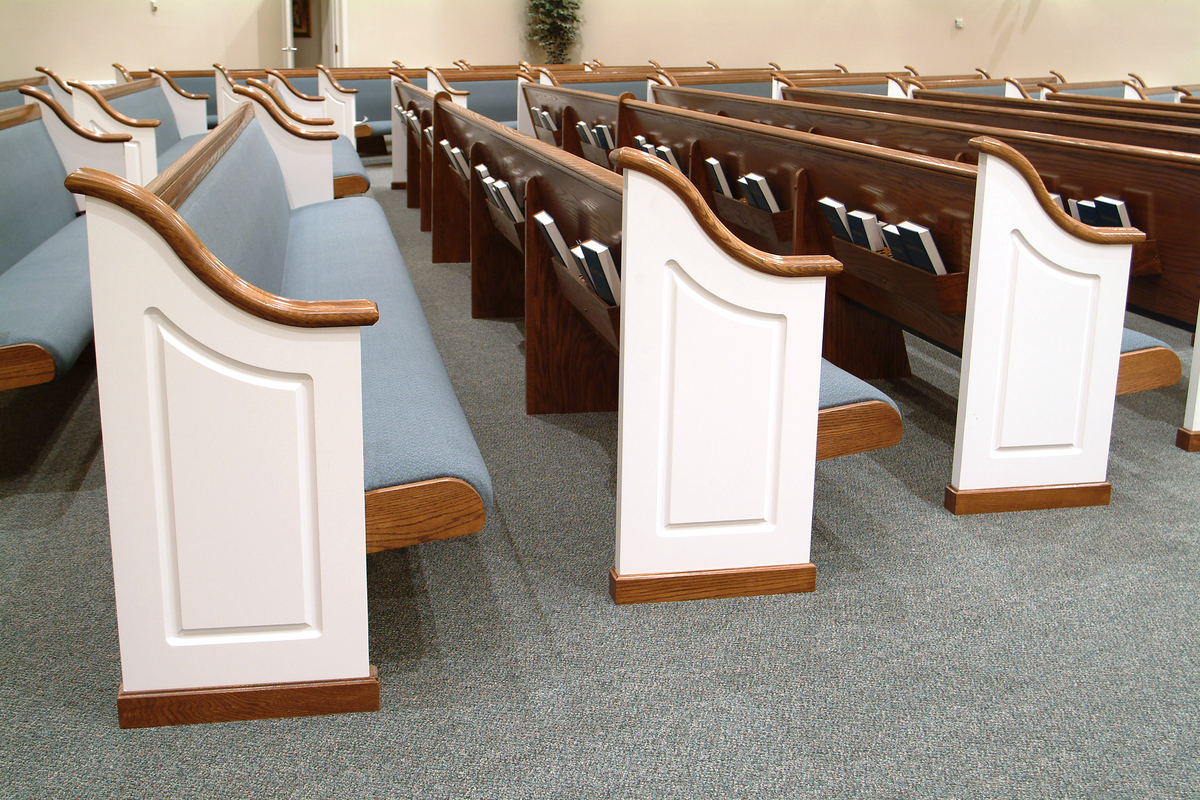
A section refinished together reads as one room. The transition falls at an architectural line rather than between two adjacent pews.
Back to topHow Scope Affects What It Costs
A smaller scope costs less than a larger one. What surprises committees is that the saving is not proportional, because part of any project is the trip: removal from the sanctuary, transport to the plant in Clinton, North Carolina, and reinstallation afterward. Those steps look much the same whether one pew travels or twenty do.
| Scope | Best fit | Matching risk |
|---|---|---|
| Structural repair only | A pew that moves but looks sound | None. The finish is untouched. |
| Repair plus refinish one pew | Back rows, side walls, less-drifted finishes | Low to moderate, depending on species and age |
| Repair plus refinish a section | Prominent pews near the front or center aisle | Low. The seam falls at an architectural break. |
| New pew built to match | Damage beyond repair | Moderate. Managed through species and stain matching. |
The practical consequence: if two or three pews in your sanctuary are heading toward the same repair within the next few years, it is worth pricing them as one project rather than returning for each. A committee that already knows the east wall pews are all showing the same water damage is better off saying so up front. For what drives a restoration number generally, see how much church pew restoration costs.
Back to topWhen One Pew Is Beyond Repair
Some damage does not respond to repair. Rot that has traveled through a pew end, insect damage inside the structure, or a break through a main structural member can all put a pew past the point where rebuilding it is sound practice. A refinisher who tells you that plainly is doing the job correctly.
In that situation the pew is replaced rather than repaired, built to match the existing style and species. Because Kivett's manufactures and refinishes in one facility, a project can include both at once: a new pew built for the one that failed, and refinishing for the pews around it so the replacement is not the only fresh surface in the room.
It is also worth asking why that one pew failed when its neighbors did not. Damage that concentrates in one spot usually points at the building rather than the furniture, and what causes church pew damage over time covers the usual causes. Fixing the pew without fixing the leak buys you a few years, not a solution.
Back to topFrequently Asked Questions
Can you repair just one damaged church pew?
Yes. A single pew can be repaired, refinished, reupholstered, or replaced without touching the rest of the sanctuary. The question that decides the scope is not whether one pew can be worked on, but whether a newly finished pew will sit convincingly beside pews whose finish has aged for decades.
Why is matching one pew to the others difficult?
Wood and finish both change with age. Decades of light, hand contact, and cleaning shift the color of a finish well away from where it started, and the change happens so gradually that nobody in the congregation notices until a fresh pew is set down next to it. Matching the original stain formula does not solve this, because the surrounding pews are no longer the color that formula produces.
What are the options if one pew is badly damaged?
There are four. Structural repair only, which keeps the existing finish. Repair plus refinishing that single pew, with the finish tinted toward the surrounding pews. Repair plus refinishing a whole visual section, such as one side of an aisle, so the transition falls at a natural break. Or a new pew manufactured to match, which is the answer when the original is beyond repair.
Can you build a replacement pew to match pews from decades ago?
In most cases, yes. Kivett's manufactures pews, pew bodies, and pew ends in-house at its Clinton, North Carolina plant, including new pieces built to match an existing style and wood species. That capability is most often used when a sanctuary expands, and the same approach applies to replacing a single pew that cannot be saved.
Is it cheaper to fix one pew than to do the whole sanctuary?
A smaller scope costs less than a larger one, but the saving is not proportional, because removal, transport, and reinstallation are largely the same trip whether one pew travels or twenty do. If several pews are heading toward the same repair within a few years, it is worth pricing them together rather than one at a time.
How do we find out which option fits our sanctuary?
Request a free consultation online or call (800) 334-1139. Kivett's inspects the damaged pew and the pews around it in person, assesses how far the surrounding finish has shifted, and puts the workable options in writing before any work is scheduled.
Related Reading
If you are still working out what your pews need, start with signs your church pews need restoration rather than cleaning. For the larger decision, see how to choose between pew restoration and new church pews, and for the work itself, what happens during a Kivett's pew restoration project. Service details are on the refinishing and church pews pages, with finished work in the pew gallery.
Tell Us About the Pew
Clinton, NC. Serving churches, synagogues, and funeral homes across the Eastern United States since 1958.